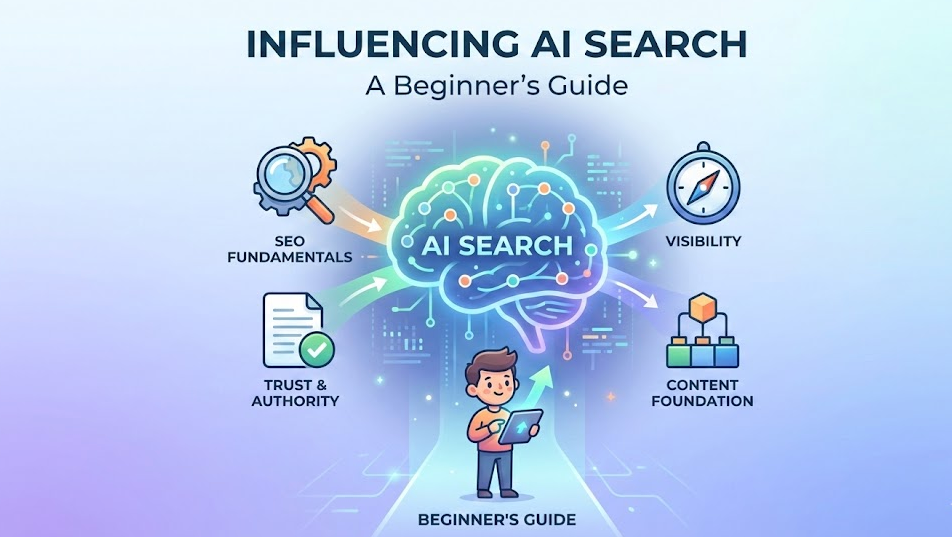
Introduction: Understanding the New Search Landscape
The age of the "10 blue links" is over. Search is now a conversation driven by AI, and brands that fail to adapt will become invisible. Fortunately, influencing these new systems isn't magic—it's strategy. We're in the era of AI-driven search, where Large Language Models (LLMs) like ChatGPT and Google's AI Overviews don't just list websites—they synthesize information and provide direct answers.
This might sound complex, but the core principles of making your brand visible to these AI systems are understandable and achievable. The good news is that influencing AI search is deeply connected to the fundamentals of traditional Search Engine Optimization (SEO). While the technology is new, the strategies for building trust and authority remain key. This guide will walk you through the core principles for improving your visibility within this exciting new ecosystem.
1. The Core Strategy: Building a Digital "Consensus"
The single most important strategy for influencing how AI models perceive your brand is building a digital consensus.
So, what does "consensus" mean in this context? It means having your brand, product, service, or name appear positively and consistently across many different, reputable websites. An AI, much like a person, looks for corroborating evidence. It tries to determine if the web "agrees" that you are an authority on a certain topic.
Consider this analogy: If a single blog post claims, "Edward is the best salesperson in the world," you'd likely be skeptical and search for other sources to support that claim. If you find no other mentions, you won't believe it. LLMs operate on a similar principle of verification. They build confidence in information when they see it repeated across multiple sources.
Here are the three primary tactics for building this digital consensus:
- Getting Featured in Listicles: Being included in articles with titles like "Top 10..." or "Best of..." is an incredibly powerful signal to an AI. When multiple independent sources list your product as a top choice, it creates a strong consensus. The impact of being added to an influential listicle can be rapid, sometimes showing results within 24 hours of the page being indexed.
- Using Press Releases (PR): A strategic press release campaign distributes your brand's story across thousands of URLs. This helps an AI connect all the relevant concepts (or "entities") associated with your brand. For example, a PR campaign can help an AI understand that your "bookstore" is specifically known for selling "historical books." Campaigns focused on releasing new statistics or data are particularly effective for building trust. For distribution, services like EIN Presswire and brandpush.co have proven effective.
- Strategic Link Building ("AI Citations"): This is a modern take on traditional link building. The goal is to get your brand mentioned (or "cited") in relevant, existing articles. A common method is to search for listicles in your industry and then reach out to the website owners with a request to add your brand to the list.
While building your reputation across the web is critical, what you do on your own pages is just as important for getting an AI's attention.
2. On-Page Tactics: How Freshness and Structure Win
LLMs are not perfect; they have specific biases and technical limitations. By understanding these quirks, you can structure the content on your own website to be more easily understood and favored by AI systems.
2.1. Leverage the "Recency Bias" with Content Freshness
AI models have a strong "recency bias," meaning they prefer and give more weight to new, up-to-date information. Creating the most current and comprehensive document on a topic is a powerful way to boost your visibility in AI-generated answers.
Here’s how to put this into practice:
- Check Your Content: Regularly review your most important articles and pages to see when they were last updated.
- Focus on the Last 6 Months: Content that has been updated within the last 180 days receives what can be considered a "booster score" in the eyes of an AI.
- Update and Republish: Make meaningful updates to your content to ensure it's current and then republish it on the exact same URL. This simple action signals freshness to AI crawlers without losing the page's existing authority.
2.2. Solve the "Middle of the Lost" Problem
LLMs can struggle to process very long documents. They tend to pay the most attention to the information presented at the beginning and the end, often "losing" the context of the information buried in the middle. This is known as the "middle of the lost" problem.
The solution is to use clear, machine-readable formatting to break up the middle of your content and help the AI process it more effectively.
The most effective formatting elements include:
- HTML Tables: These are especially effective for presenting data, features, or any comparison-style content.
- Bulleted or Numbered Lists: Lists break up long paragraphs and present information in a highly structured, easy-to-digest format.
- Semantic Tags: Using proper heading structures (H2, H3, H4) creates a logical hierarchy that helps both users and AI crawlers understand the flow of your document.
These formatting elements are more than just an AI-specific trick; they are a core part of a sophisticated SEO strategy. By breaking up text with tables and lists, you improve the user experience, which often increases the average time a visitor spends on your page. Higher user engagement can help you rank higher in traditional search engines. And when you rank higher, your content is more likely to be included in the LLM's "reranking process," which can almost double your chances of being cited in an AI-generated answer.
2.3. Answer Real Questions to Drive Conversions
Visibility is only half the battle; the ultimate goal is to drive conversions. The most direct path to this is by answering the specific questions your potential customers are already asking.
The core tactic is to find hundreds of real user questions from platforms where your audience is active, such as Reddit, social media, and forums. Group these questions into topic clusters and use them to create highly relevant content. This can take the form of dedicated FAQ sections at the end of articles, headings within your blog posts (using H2s, H3s, and H4s), or even ideas for entirely new supporting articles. By directly addressing real-world queries, you create content that not only satisfies AI systems but also effectively guides users toward a purchase.
Once your own website is fresh and well-structured, the next step is to expand your influence across the entire digital ecosystem.
3. Beyond Your Website: A Multi-Platform "Parasite SEO" Strategy
A successful AI visibility strategy doesn't put all its eggs in one basket. Instead of relying solely on your own website, you should aim to establish a presence on multiple high-authority platforms. This approach, sometimes called "Parasite SEO," allows you to compete for visibility with multiple domains that you control or influence, not just your own. This strategy works by leveraging the immense domain authority of major platforms, allowing your content to rank faster and more easily than it might on your own newer or less authoritative website.
"...if you are just running your own website you are only running one single domain... but if you own if you manage your own content stack and platforms you are trying to compete with multiple domains and I believe this is the best way to... show your ex um experience show your uh trust."
By creating content across these platforms, you build a wider net to demonstrate your expertise and build trust with AI systems.
| Platform | Why It's Effective for AI Visibility |
| YouTube | Described as "very underrated" and an effective way to demonstrate expertise through video content. |
| Mentioned as "very essential" for AI visibility and a place where strategic engagement can pay off. | |
| Publishing articles can be very effective, as demonstrated by experiments showing a new article ranking within 24 hours. | |
| Quora & Medium | These platforms are frequently crawled for answers and serve as key venues for demonstrating authority and expertise. |
| Facebook Groups | Gaining popularity for "parasite SEO" efforts, especially in less competitive niches. |
| Other Socials (X, Instagram) | X threads and SEO-friendly Instagram descriptions are also picked up by LLMs. |
All these strategies—consensus, freshness, and multi-platform presence—rest on a solid technical foundation.
4. Your First Steps to Better AI Visibility
Improving your visibility in AI-driven search is not about chasing algorithms; it's about implementing a holistic strategy. You begin by building external consensus across the web to establish your authority. Simultaneously, you optimize your owned assets—your website—to be perfectly structured for AI consumption and user engagement. Finally, you amplify that authority across a diverse digital ecosystem to maximize your footprint and dominate your niche. This three-part system ensures your brand is not only seen but trusted by the AI-driven search engines of today and tomorrow.
What to Do Next
- Audit Your Content for Freshness: Identify key pages on your site that haven't been updated in the last 6 months. Schedule them for a refresh to make the information current and relevant.
- Add More Questions: Review your most important articles and add a simple FAQ section at the end using H3 or H4 headings. Find real user questions on platforms like Reddit or Quora to ensure your answers are relevant.
- Improve Your Formatting: Find a long, text-heavy blog post on your site. Break up the middle section with bullet points or a simple comparison table to make it easier for both users and AIs to parse.
- Start Your "Consensus" Campaign: Identify one prominent "best of" listicle in your industry and begin planning a strategy to reach out and get your brand mentioned there.